Sunday, December 9, 2007

Nun, Gimel, Heh, and Shin by Author Unknown

Nun, Gimel, Heh, and Shin,

Nun, gimel, heh, and shin,
See the wooden dreidel spin.
Nes gadol hayah shin,
If I'm lucky I will win!

I play with my new dreidel
upon the shiny floor.
I ask some friends to play with me-
we must have two or more.

I give the players pennies-
the same amount to each.
We sit down in a circle,
the pennies within reach.

Each player puts a penny
in the proper spot.
The middle of the circle
is what we call the pot.

Next I take the dreidel
and spin it round and round.
Which letter does it land on?
What fortune have I found?

I read the letter facing up-
it tells me how to play.
The letters are in Hebrew,
and here is what they say.

Nun means I do nothing-
I neither give nor take.
Heh means I take half the pot-
what a lucky break!

Gimel means I take it all.
It looks as if I'll win!
But I must put a penny back
when it lands on shin.

We go around the circle-
it's lots and lots of fun,
till one has all the pennies.
Then the game is done!

Nun, gimel, heh, and shin,
See the wooden dreidel spin.
Nes gadol hayah sham,
If I'm lucky I will win!
--Unknown


Here's a poem without any sort of poetic language at all. Yes, it rhymes, and the rhythm is mostly regular, but it exists to impart information rather than to set a mood or express information. I'm posting it because it's handy to be reminded of the rules of the game every once in a while.

We were watching Chuck on TV last week, and one of his co-workers kept cheating everybody at the dreidel game -- if they protested, he's as if they had been through a bar-mitsvah. We got the impression that he didn't really know the rules either, but made them up as he went along. It was pretty funny. You should watch that show if the writers ever stop striking and they make some new episodes.

I remember the year Mom got us all plastic dreidels at Hanukkah and taught us how to play. I put mine in my backpack, and while walking home from school one day (it was about a about a mile and a half), David and I decided to play. It's amazing how quickly one can get good at spinning a top in the palm of one hand while holding a handful of pencils in the other (the other person's spare hand is the pot). It's kind of silly, I know, but it's the stuff memories are made of.

Saturday, December 8, 2007

Happy Hanukkah! by Eva Grant

Happy Hanukkah!

Outside, snow is slowly, softly
Falling through the wintry night.
In the house, the brass menorah
Sparkles with the candlelight.

Children in a circle listen
To the wondrous stories told,
Of the daring Maccabeans
And the miracles of old.

In the kitchen, pancakes sizzle,
Turning brown, they'll soon be done.
Gifts are waiting to be opened,
Happy Hanukkah's begun.
-- Eva Grant


Eva Grant has also written a lot of Hanukkah poems (do a Google search to find a thorough sampling), but they mostly fall into the extremely simple category I was complaining about yesterday. This one at least gives you a feeling of holiday domestic warmth, but it still feels like the scene and sentiment belong on a Hallmark card. The picture on the front would be pretty -- They could use cool toned colors to compare the cold snow with the sparkling menorah -- maybe they could even put some glitter on it. Inside, the colors would be warm -- there would be candle light on the awestruck faces of the children around the table listening to Grandpa while Grandma looks on fondly from her station at the stove frying latkes.

Why is there such a dearth of good holiday poems? There are certainly enough lousy ones, so it's not like poets ignore the holidays. It seems to me that holidays are when emotion runs highest, and what is poetry but a way of expressing emotion? When I really think about it, I suppose that most of the good Christmas poems have been set to music, and there are PLENTY of Christmas songs out there. There are also a lot of poems appropriate for Easter, though most of them were written about Christ and his resurrection than the holiday itself. There's no shortage of love poems for Valentines day, or Irish poems and folk songs that can be used at St. Patrick's, but again, those were written about the thing the holiday is celebrating rather than about the holiday itself. I'd love to hear your thoughts on the topic.

Friday, December 7, 2007

How Explain the Miracle of Light by Nicholas Gordon

How Explain the Miracle of Light

How explain the miracle of light?
A lamp's a miracle, refueled or no.
Nor is there aught that ought be more than night,
Unless some unmade maker make it so.
Know that nothing is but miracles,
Kindled from the void we know not how;
And God, if God there be, the greatest miracle,
Here within the sepulcher of now.
--Nicholas Gordon


I was looking for a poem for Hanukkah and, as usual for holiday poem searches, I found a bunch of simple, trite poems suitable for elementary school children to practice their handwriting on, but not much else. Then I stumbled on Nicholas Gordon's Hanukkah Poems. I was delighted to find even one that had a bit more substance to it, let alone several, so I'll post it today, and then do some simple ones later in the week.

Gordon's poems get a bit repetitive if you read them all, but by itself this poem really hit me. I like how he plays with words like "aught" and "ought" or "unmade" and "maker." I also like that the acrostic part of the poem is subtle -- it's not the "H is for Happiness" kind of poem that gives acrostics a bad name.

On the down side, his language is a bit obscure, and I'm not entirely sure what he's saying all the time. This is a poem that feels like it needs some heavy duty analysis, and I think that kind of language turns many people off to poetry in general.

On the whole though, it's a nice message for Hanukkah: Yes, A Great Miracle Happened Here, but do we really need that miracle to let us know that there is a God? Isn't the mere fact of existence miracle enough?

PS: Yes, I know the menorah in the picture isn't a Hanukkah menorah, but it's close enough, and the rest of the picture was too perfect to pass up.

Thursday, December 6, 2007

There Was an Old Man With a Beard by Edward Lear

There Was an Old Man With a Beard

There was an old man with a beard,
Who said, "It is just as I feared!--
Two owls and a hen,
Four larks and a wren,
Have all built their nests in my beard!"
--Edward Lear


I really have nothing to say about this poem -- it's one of Lear's most famous limericks, but there's nothing especially special about it. I picked it today for precisely that reason. I wanted to revisit my comments on another poem, and didn't want to shortchange a new one that I had something to say about.

A few days ago I was looking through the comments people have left on the site, and found that somebody wrote a very angry (and and offensively worded) comment about The White Man's Burden. I don't mind that -- the poem has indeed been used to justify some truly awful things whether Kipling intended it to or not (which is still up in the air--I personally don't think he did, but I only know his writings, I didn't know him or his intentions). At any rate, I re-read the poem and my own comments, and I was struck once again by the question, "Who did they think they were? Why should their version of civilization and religion be any better than what the people had already? Why couldn't they just go away and leave them alone?"

This has always been a hard question for me because there are obviously some things we know about that can make people's lives better -- things like hygiene practices, methods of farming, irrigating, purifying water, reading, and yes, even the gospel. At the same time, I think it's terrible for people to lose their heritage and forget what it was that their fathers believed and how they lived. The European colonial missionaries did immense social, cultural and historical damage on top of the physical damage done by the conquerors. Knowing that, can I really say that anyone was truly better off after they were taught?

Last night, Peter and I were watching the Stargate SG-1 episode Origin where a missionary from a new set of "gods" show up in our galaxy. Having just defeated one set of false gods, our heroes are naturally skeptical, but essentially tell they guy, "We don't mind if you preach, we don't mind if people in our galaxy choose to worship your gods (who do have real power), but we aren't going to stand for it if you come in here and force everybody to worship on pain of extermination."

Finally, it clicked for me. We claim the privilege of worshipping almighty God according to the dictates of our own conscience and allow all men the same privilege let them worship how where or what they may (AOF 11). Because we have the knowledge, it's our moral responsibility to teach others. Because God gave us free will, we aren't morally responsible for forcing people to believe us and/or take our advice. We should do our best to make sure they really and truly understand what we have to say, but in the end, they get to choose. When people in Africa refuse to let their local pond or river get treated against malaria and guinea worm, the aid workers don't kill everybody in the village who objects -- they argue, they try to persuade, and then if they fail, they move on to the next village and vow to try again next year.

So that's the burden that people everywhere should take up -- doing your best to make the world a better place while allowing others to make their own decisions.

Wednesday, December 5, 2007

Stopping by Woods on a Snowy Evening by Robert Frost

Stopping by Woods on a Snowy Evening

Whose woods these are I think I know.
His house is in the village, though;
He will not see me stopping here
To watch his woods fill up with snow.

My little horse must think it queer
To stop without a farmhouse near
Between the woods and frozen lake
The darkest evening of the year.

He gives his harness bells a shake
To ask if there is some mistake.
The only other sound's the sweep
Of easy wind and downy flake.

The woods are lovely, dark, and deep,
But I have promises to keep,
And miles to go before I sleep,
And miles to go before I sleep.
--Robert Frost


This poem is arguably one of the most beloved American poems ever written. I think it's because it so beautifully captures a moment that many of us have experienced -- they quiet entrancing beauty of falling snow. It doesn't matter that many people haven't got woods to watch snow fall on -- my most memorable snow watching happened in the middle of St. Petersburg Russia walking past the Cathedral on the Blood (one of the most beautiful buildings in the world) beside the canal and staring directly up into the falling snow as it sparkled in the streetlights.

Most of us don't have horses either, though I think it's an important part of the poem to have something observing the observer. The horse is not quite silent, but the single shake of jingle bells only accentuates how very hushed the world is. There's no wind blowing, no birds chirping, no bustling crowds, and the soft presence of the snow dampens the few sounds that are there.

I haven't got any snow this year (or any prospect of it), and rain, though welcome and hypnotic in its own right is not quite the same. A few of my friends in other parts of the country recently posted pictures of snow and how it changed their perspective, so this seemed like a good day to post this poem that I've been saving.

The end of the poem reminds me that I ought to sign off -- I too have miles to go before I sleep (it's my day to go visit my grandparents in HB, and I also have work to do on my manga rewrites). At the same time it reminds me that it's important to take the time to stop and look at the beautiful things around you -- even if it is just for a few moments. I haven't been doing that this week since I've been neglecting my blog. I've come to realize that it really is a great way for me to find a little bit of beauty every day and really reflect on what I'm feeling.

Friday, November 30, 2007

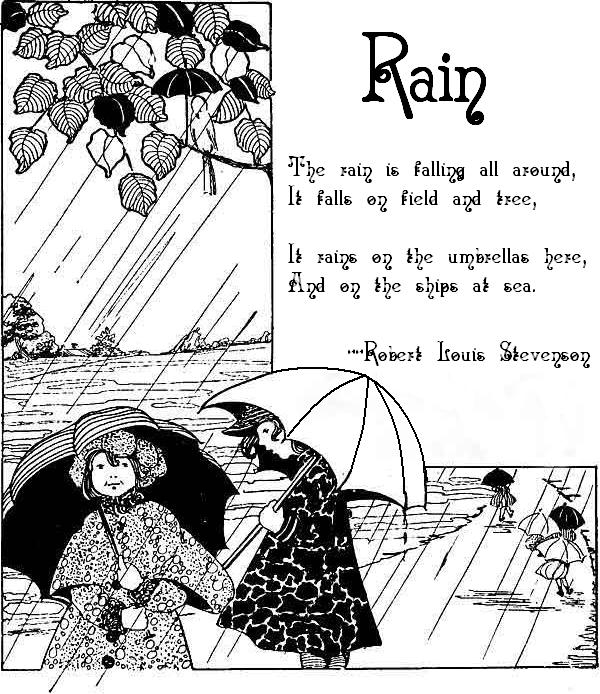
Rain by Robert Louis Stevenson

Rain

The rain is falling all around,
It falls on field and tree,

It rains on the umbrellas here,
And on the ships at sea.
--Robert Louis Stevenson


I have a special fondness for this poem, though the source of the fondness is of a more recent date than most of the poems I have a special fondness for. Last year I was tutoring a little girl named Fatima. She needed help in reading, mostly because English was her second language, and she simply didn't have the vocabulary to recognize when she had sounded out a word correctly. During our tutoring sessions, I brought storybooks to read along with the worksheets and vocabulary building exercises that I was required to use. One day, we read a book of nursery rhymes, and she LOVED it. She recognized a few of them, but mostly she liked the predictability of the rhythm and rhyme in poetry.

As a tutor, I'm quick to grab hold of anything that motivates a child, so I brought her more poetry: Shel Silverstein, Jack Prelutsky, Robert Louis Stevenson and even some Haiku. She liked reading poems herself, but she also loved hearing me read them since I could do it with more fluency, and she could get the full effect. She was especially impressed when I showed her that I had some of the poems memorized and could recite them without looking at the words. She decided that she really wanted to do that too, and picked this poem as her first (she already knew some nursery rhymes, as I've said, but this was the first she set out to memorize as a poem).

We copied it down onto a little piece of paper that she kept in her desk and she practiced it for weeks, finally getting it just right. We copied down a few others that she especially liked, but I soon realized that it would take too long to do much more of that during tutoring. That's when I set out to compile a book of poems for her--including the best of the ones she'd already read, and some more of my favorites for her to grow into. While compiling poems and illustrations for her little book, I found many others that I loved, but which didn't fit the scope I had decided on. It was at that point that I decided to start this blog.

Anyway, it rained all day today -- We haven't had this much rain at once in months and months -- maybe not since last winter. It was nice to wake up last night to the sound of rain, and it was nice to have the rain wash away a lot of the ashy dust from the wildfires and general smog. My biggest complaint about living in California is that I miss the rain (though my biggest reason for liking it is the constant sunshine). If we could get a good thunderstorm rolling through about once a month, I think that would be the perfect compromise.

Thursday, November 29, 2007

I'm a Little Teapot by George Sanders and Clarence Kelly

I'm a Little Teapot


I'm a little teapot, short and stout
Here is my handle, here is my spout
When I get all steamed up, hear me shout
Tip me over and pour me out
--George Sanders and Clarence Kelly

I'm a little teapot, short and stout
Here is my handle, here is my...other handle
Oops...
I'm a little sugar bowl short and stout...
--Author Unknown


Here's another from my intermittent series on poems with funny responses. I don't think it needs much explanation.

I've been feeling more and more like a teapot lately, not so much short, but definitely round and bulgy. Even my stretchiest pants don't fit around my belly anymore, and driving is starting to be a problem (If I recline far enough to keep from squishing my belly, then my arms aren't long enough to reach the steering wheel).

Yesterday I decided to take a nap on the couch (My doctor has been suggesting daytime naps to make up for my lousy sleeping at night). I was only out for an hour or so, but I neglected to prop up all the relevant bits with pillows like I do at night. Bad Idea! I was SOOOO sore all evening. I felt like somebody had folded me in half, then roughly unfolded me but neglected to work the kinks out of my ribs and spine. Consequently, it felt like very sharp bony bits were poking thru my innards -- especially my lungs (which were in bad shape to begin with having been squished for weeks now).

While I was trying to describe how I felt to Peter, I remembered a game Daddy used to play with us. He'd say, "Gravity Belt OFF!" and hold some body part up in the air while we tried to get it down. Then when he got tired, he'd shout, "Gravity Belt ON!" and crush whoever he was playing with to the floor under an enormously heavy arm or leg (Telling it like this, it sounds like seriously abusive behavior, but Daddy always knew just how hard he could push without actually hurting a child, and if we really wanted to stop, he would). Anyway, last night I felt like somebody shouted "Gravity Belt ON!" and then forgot to turn it off.

There's six weeks to go in this pregnancy, but I am SO ready to be done with it and see the baby for real.